Search This Blog

Saturday, May 12, 2012

Book of Mormon missionary tool


The Book of Mormon

Another Testament of Jesus Christ


A soon to be sister missionary for the Church of Jesus Christ of latter Day Saints reads from an original 1830 edition of the Book of Mormon, owned by Helen Spencer Schlie.  Sister Schlie has shown this book at firesides, in her bookstore, and has used it as a powerful testimony of the Book of Mormon.  The book is old and worn now, but has been instrumental in the conversion and strengthening of testimonies in hundreds of individuals.

Rather than let this old and worn book sit in some musty old museum to viewed by a handful of curious visitors, Sister Schlie has chosen to dismantle the book page by page for those who desire to have  their favorite scripture framed and displayed on an authentic page from this original 1830 printing of the Book of Mormon.

I had such a desire, to have my favorite scripture, Alma 17:18-38, which can be found on the page 271-272 of this original Book of Mormon, framed so that I could demonstrate to others the truth and power which can be gleaned from the Book of Mormon.


Page 271-272 from Helen Spencer Schlie’s original 1830 edition of the Book of Mormon


This page contains the text from Alma 17:18-38, the story of Ammon and King Lamoni.  There is a power of scripture, and a power of conversion in this page, as it is read, handled and contemplated.  This page has the power to build testimonies and change lives, just as “the shadow of Peter” could heal the sick as told in Acts  5:15; “they brought forth the sick into the streets, and laid them on beds and couches, that at the least the shadow of Peter passing by might overshadow some of them”.

Why this page?  Why this particular part of scripture?   As we read in Alma 17, we learn of how the sons of Mosiah “had waxed strong in the knowledge of the truth; for they were men of a sound understanding and they had searched the scriptures diligently, that they might know the word of God”. (Alma  17:2), “they had given themselves to much prayer, and fasting; therefore they had the spirit of prophecy, and the spirit of revelation, and when they taught, they taught with power and authority of God” (Alma  17:3).  “They fasted much and prayed much that the Lord would grant unto them a portion of his Spirit to go with them, and abide with them, that they might be an instrument in the hands of God to bring, if it were possible, their brethren, the Lamanites, to the knowledge of the truth, to the knowledge of the baseness of the traditions of their fathers, which were not correct” (Alma  17:9).

Now, Ammon went to the land of Ishmael (Alma  17:19), but as he “entered the land of Ishmael, the Lamanites took him and bound him, as was their custom to bind all the Nephites who fell into their hands, and carry them before the king; and thus it was left to the pleasure of the king to slay them, or to retain them in captivity, or to cast them into prison, or to cast them out of his land, according to his will and pleasure” (Alma  17:20).  After interviewing with the king, King Lamoni was much pleased with Ammon, and caused that his bands should be loosed (Alma  17:24).  Ammon told the king that he would like to be his servant, and” was set among other servants to watch the flocks of Lamoni”  (Alma  17:25). 

“And after he had been in the service of the king three days, as he was with the Lamanitish servants going forth with their flocks to the place of water, which was called the water of Sebus, and all the Lamanites drive their flocks hither, that they may have water—“ (Alma  17:26), when “behold, a certain number of the Lamanites, who had been with their flocks to water, stood and scattered the flocks of Ammon and the servants of the king, and they scattered them insomuch that they fled many ways” (Alma  17:27).

“Now the servants of the king began to murmur, saying: Now the king will slay us, as he has our brethren because their flocks were scattered by the wickedness of these men. And they began to weep exceedingly, saying: Behold, our flocks are scattered already. Now they wept because of the fear of being slain. Now when Ammon saw this his heart was swollen within him with joy; for, said he, I will show forth my power unto these my fellow-servants, or the power which is in me, in restoring these flocks unto the king, that I may win the hearts of these my fellow-servants, that I may lead them to believe in my words” (Alma  17:28-29).

This single sentence of scripture; “that I may win the hearts of these my fellow-servants, that I may lead them to believe in my words”, is the reason that I desired to have this particular page from the original 1830 edition of the Book of Mormon.  In this sentence, Ammon declares the very essence of missionary work, “that I may win the hearts of these my fellow-servants, that I may lead them to believe in my words”. 

We have been admonished by latter-day prophets to:

President David O. McKay advised, “Every member a missionary”;
President Kimball: “Lengthen your stride” and “Do it now”;
President Benson: “Flood … the earth with the Book of Mormon”;
President Hinckley: Increase the number of converts and retain them.
President Monson: Restore the gospel to the inactive members of the churchl.

Through this scripture Ammon has shown us the way; he has given us the means of declaring the gospel to those who will “believe in my words”.

The story goes on to show how Ammon restores the flocks to the king, and does indeed find favor with King Lamoni such that the king says “whatsoever thou desirest I will give unto thee; and if it were needed, I would guard thee with my armies” (Alma 18:21).  Ammon “said unto Lamoni: Wilt thou hearken unto my words” (Alma 18:22)?  “And the king answered him, and said: Yea, I will believe all thy words” (Alma 18:23).

“And it came to pass that there were many that did believe in their words; and as many as did believe were baptized; and they became a righteous people, and they did establish a church among them.  And thus the work of the Lord did commence among the Lamanites; thus the Lord did begin to pour out his Spirit upon them; and we see that his arm is extended to all people who will repent and believe on his name” (Alma 19:35-36)


BofM   BofM  BofM  BofM  BofM  BofM  BofM  BofM  BofM  BofM  BofM  BofM  BofM 


I MISSED IT !!!

I was so excited with the message of pages 271-272, the story of Ammon and King Lalmoni, and Ammon’s powerful missionary message in Alma 17:29 ”that I may win the hearts of these my fellow-servants, that I may lead them to believe in my words”, that I just left the story there, but as I was out walking the dogs this morning, I reviewed the rest of the story in my mind.

After the servants of the king returned and relate the story of how Ammon had rescued the kings flocks from the Lamanites, the king can but wonder who this man is. “Behold, is not this the Great Spirit who doth send such great punishments upon this people, because of their murders?” (Alma 18:2).

When Alma is brought before king Lamoni, the king ponders him in his mind; it is a full hour before the king can even speak to Ammon (Alma 18:14). When Ammon perceives the thoughts of the king he says: “Is it because thou hast heard that I defended thy servants and thy flocks, and slew seven of their brethren with the sling and with the sword, and smote off the arms of others, in order to defend thy flocks and thy servants; behold, is it this that causeth thy marveling”?  (Alma 18:16).

“Now when the king had heard these words, he marveled again, for he beheld that Ammon could discern his thoughts; but notwithstanding this, king Lamoni did open his mouth, and said unto him: Who art thou? Art thou that Great Spirit, who knows all things”? (Alma 18:18).

“Now Ammon being wise, yet harmless, he said unto Lamoni: Wilt thou hearken unto my words, if I tell thee by what power I do these things? And this is the thing that I desire of thee. And the king answered him, and said: Yea, I will believe all thy words. And thus he was caught with guile”. (Alma 18:22-23), thus fulfilling Ammons desires expressed in Alma 17:29.

And now comes Part II; Ammon’s desires to have them “believe in my words” has been met. Now the Lord would desirethe same thing, that king Lamoni believe with a surety that He is the One True God, and believe in Him that he might believe in His Words, for when Ammon asks the king “Believest thou that there is a God”? the king answers him “I do not know what that meaneth”. (Alma 18:24-25).

Ammon rehearses to king Lamoni who God is, and tells him of His wondrous works from the beginning of the creation down to the present day. When Ammon had finished these things the king “ began to cry unto the Lord, saying: O Lord, have mercy; according to thy abundant mercy which thou hast had upon the people of Nephi, have upon me, and my people. And now, when he had said this, he fell unto the earth, as if he were dead.” (Alma 18:41-42).

For the space of three days “king Lamoni was under the power of God; … the dark veil of unbelief was being cast away from his mind, and the light which did light up his mind, which was the light of the glory of God, which was a marvelous light of his goodness--yea, this light had infused such joy into his soul, the cloud of darkness having been dispelled, and that the light of everlasting life was lit up in his soul, yea, he knew that this had overcome his natural frame, and he was carried away in God—“ (Alma 19:6).

When, by the power of God, king Lamoni is raised from his sleep, he begins to “to teach them” (his people) ”the words which he had heard from the mouth of Ammon; and as many as heard his words believed, and were converted unto the Lord”. (Alma 19:31).

And now through His power, God has taught king Lamoni that He is the One True God, and now King Lamoni is ready to believe all his words.  And thus a great work was done in the land.  This was a pivotal point in the teachings of God unto the Lamanites.


BofM   BofM  BofM  BofM  BofM  BofM  BofM  BofM  BofM  BofM  BofM  BofM  BofM  BofM 


The following is a full size reproduction of an original typeset page and page detail for the first sixteen pages of the Book of Mormon as printed by Mr. E. B. Grandin.  Each typeset page contained sixteen pages, front and back, which were printed on a single sheet.  There were 185,000 sheets that would eventually be folded, cut, and bound to create the 590-page Book of Mormon.

5000 copies of the book were printed at the cost of $3000 and sold for $1.25 apiece. 


What is your favorite Book of Mormon scripture?  Choice scriptures are still available from this original 1830 edition of the Book of Mormon. 

Contact Helen Spencer Schlie at http://facebook.com/helenspencerschlie


Saturday, January 7, 2012

Symphony Dog

A Night at the Symphony

 Gary Hyde
April 30, 2009


The Phoenix Symphony was presenting their Symphony Classics No. 14 with conductor Michael Christie. The featured work would be Organ Concerto in G minor, by Francis Poulenc.   Also on the program was Bach’s Toccata and Fugue in D minor, Jennifer Higdon’s Machine, and Saint-Saens Organ Symphony with Paul Jacobs as the guest organist. Besides being the chairman the Julliard School organ department Paul has many other musical accomplishments to his name.  In 2002 at age 23, Paul celebrated the 250th anniversary of the death of J.S. Bach by playing a collection of the composer’s complete organ music in an 18 hour non-stop marathon.

 This is one performance which I am really excited to attend.  It is unfortunate that I have put myself into a position where I will have to attend it alone.  After taking each of my grandchildren to either an opera or a symphony, they have all put their collective foot down and proclaimed that they will never attend another opera or symphony with me again.  I guess you can take the boy out of the country, but you can’t take the country out of the boy.  Of course they are not here at the time anyway so it makes no difference.  Now my son Mike, he would go with me.  He plays the piano and the organ and I think that he would really appreciate this kind of presentation.  But then of course he’s not here either.  Now Sharon, my wife; you would think that I would ask her, but I know that after the first ten minutes she would run screaming from the hall with her hands covering her ears.

 So here I am; center section, second row, and all alone.  These are good times!

 The night began with a brief discussion period between symphony conductor Michael Christie and organist Paul Jacobs. They discussed the pieces to be played, Paul’s musical background and a bit about the organ he would be playing.  It was an electronic organ, three keyboards with many organ stops and a full array of foot pedals. Gigantic speakers were located in the back of the orchestra stage to give the organ all the authority it needed.

 Following the discussion, the orchestra members started to filter on to the stage and began tuning up their instruments and brushing up on any difficult pieces they would be playing. The tuning session; this is about the time when my wife Sharon would run screaming from the hall shouting “Enough!  Enough!  How can you stand all that noise”?

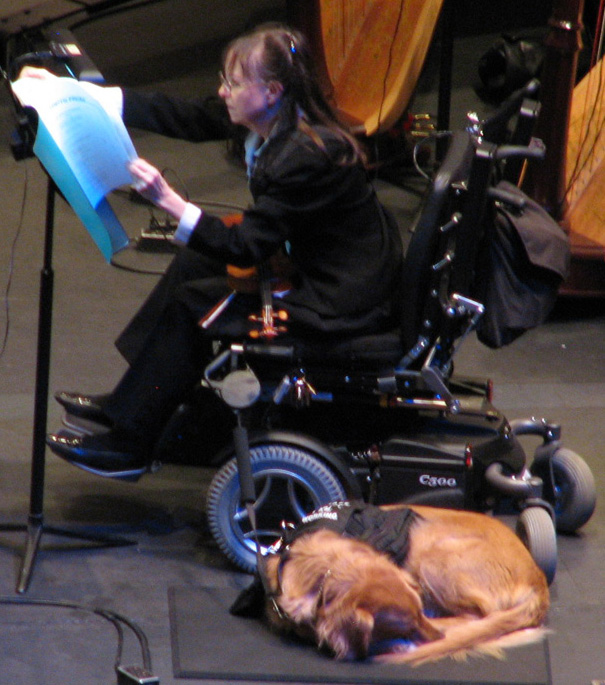
As the orchestra was filling up, I noticed one violinist who was confined to a wheel chair.  She had the assistance of a service dog and as she entered onto the stage, the dog walked along side, winding his way through chairs and music stands until they finally reached the proper position in the orchestra; there she started to set up her music and stand.  As she moved from the music stand, to the violin case, then back to the music stand, Dog would move around trying to keep out of her way.  First, she laid her violin case down on top of  Dog, then as she tried to set up her stand, in a clumsy attempt to get out of her way, Dog bumped into the stand, tipping it over, resulting in a loud crash with sheets of music scattered all over the floor.  Other musicians helped her pick up the stand and arrange her music again.  Just as it seemed that she had it all under control the set up period was over and the orchestra members left the stage so Dog had to get up and follow.  

 After a short period the entire orchestra entered again onto the stage, with Dog in tow. After picking up their instruments for one final tune they were ready to begin.  Once Dog found his place, he just lay down, looked around, and went to sleep.

 The first selection, Fugue and Cantata, was powerful and energetic.  It was played by the orchestra with wind and stringed instruments, but not the organ.  This is one of my favorite organ pieces, but I guess I can manage.

 Next was Francis Poulnec’s Organ Concerto in G minor.  It was a wild piece of music that brought out the passion of each musician.  As the music would crescendo, each head would raise and fall with the music while the violinist’s bows would disappear into a blur as they were played across the strings. At one time the crescendo was so great that as the conductor was reaching forward to get the most from his orchestra he almost pitched forward off the podium. At the conclusion, the audience was on their feet.  “Bravo, bravo!’  It was insane. 

In appreciation of the endless applause Paul played an organ encore that was just fantastic.  At times his hands would appear to just flutter over the keys, with a touch as light as a feather.  Then he would pick up the pace, hands flying from keyboard to keyboard, pushing and pulling at the stops, and his feet dancing around the pedals just as fast as his hands were going on the keys.  At one time he stopped playing with his hands, held them down at his side and played entirely with his feet with movements that would make any tap dancer envious.

 As moving as it all was, Dog was not impressed.  Occasionally he would rise up his head from a sound sleep, look at his master as if to say “Is it over yet?”;  then, getting no response he would yawn, lay his head down and go back to sleep.

 During the intermission there was a brief question and answer period where the audience could ask the organist, Paul Jacobs, any questions.  One man noted that he seemed to hear the organ let out a screech during the last piece played.  Being fast on his feet, Paul exclaimed…..”Yes, that is one of the great things about the organ.  You can play the keys and push the knobs into many combinations and make any kind of sound you want.  Guttural, blaring, scratchy, or even any other type of musical instrument you wish.

 After the final piece had been performed, the applause had died down and the last curtain call had been made, the orchestra gathered their instruments and started to move off stage.  The wheel chair bound lady was the last to leave, so Dog just had to lay there and suffer all the indignities of having everyone step over him, bump into him and have the long ladies gowns brush over his head and body.

 I mean, honestly now, how can anybody not enjoy entertainment like that?


Tuesday, November 1, 2011

MountainBrook Shih Tzu Conquers Summit of Silly Mountain

Tuesday, Jan 14th , 2003


Written by Gary Hyde


In the early dawn hours of Tuesday morning, the brave little Shih Tzu “Sir Pippin”, accompanied by a hardened group of climbers from the little hamlet of MountainBrook made an attempt at the summit of Arizona’s 2139 foot Silly Mountain.  The group left the MountainBrook Activity Center and traversed a desolate stretch of the Sonora Desert to the base camp at Silly Mountain.  While most of the party wanted to rest before making the ascent, Sir Pippin insisted that they press on before the hot desert sun would have a chance to take its scorching toll on the climbers.

While the ascent was steep and rocky, Sir Pippin scrambled up the trail as if he had an extra pair of legs.  Waiting at times for the other fatigued climbers, Sir Pippin arrived at the summit just as the red morning sun was making its appearance over the crest of Picket Post Mountain.  This awe inspiring sight was all that was needed for the final fifty foot ascent to the craggy peak of the mountain.

This reporter was the first to interview Sir Pippin after his monumental achievement.  When asked how he so untiringly made it to the top, long ahead of his fellow climbers he humbly replied,  “I just kept the vision of my mentor Corbin Volluz focused in my mind.  After his daring climb to the top of the Flatiron, I figured if he could do that, surely I could do this.  I only wish he were here with me now to share in this moment, but alas he is still recuperating from acute muscle fatigue sustained during his climb.  Good luck Corbin and I hope you are able to walk again soon”.

When asked what drove him to such a climb, Sir Pippin simply stated; “Because there was a bush up there.”

Yes folks, so long as there are daring and courageous climbers like Sir Pippin among us no mountain will remain unclimbed nor any bush remain unsniffed.

Wednesday, July 20, 2011

Nothing To Do

While walking the dogs last night we came across a small neighborhood park that had just installed a new Jungle Jim; it had a swing set, a couple of sides, and a small climbing wall with some stairs leading up to the slide and wall platform.  There were four children standing around; two of them, about seven years of age, were swing on the swings, while the other two, about age eleven, were just standing around watching.

 As we walked by I heard one of the boys say “What do you want to do”?  The other replied “I don’t know there’s nothing to do”.  Passing by I told the older boys “Too bad you guys are too big to use the climbing wall.  I’ll bet it would be fun”.   As we walked out of the park, I looked back and noticed that the two older boys had started to climb up the climbing wall, and as we rounded the corner of the park, one of the smaller boys yelled back at us “I made it to the top”.

Saturday, June 11, 2011

Developing Our Talents

 
My son Mike has been taught piano by Kay, his instructor, for years.  Kay has two sons of her own; Robin, who is a music instructor at BYU and a concert pianist, and  Randal, his younger brother who has been deaf from birth. 
Robin developed his talent for playing piano at a very young age.  His mother, being a piano instructor herself, taught him the basics and nurtured him along with his music. Today, Robin teaches music at BYU and plays concerts all over the world.
Randal was born deaf, but was soon placed in a school for the deaf where he became very proficient at reading lips.  By developing this talent, Randal was able to communicate with others and complete a master’s degree in Education for the Deaf and Blind.

Last year Randal wrote his mother and told her that he had bought himself a used grand piano from a church that was switching its music venue from piano to guitar and drums.  Now that he had a piano he told her that he would like to learn to play.  “That would be wonderful” she said.  “But what would you like me to do? I live in Washington, and you live in Utah.  I can’t come down there for lessons, what do you suggest”?  Like the Brother of Jared (Ether chapter 3), Randal   knew what he wanted and he had the faith that his mother could help him.  “Go out and buy yourself a web cam for your computer and we can correspond over the internet via the video cam.  You can speak what I should do, and I can read your lips and learn how to play”.  She did, and he did.  He has recently been called as the ward baptismal pianist.  He plays at all of the ward baptisms.  When he finishes playing a piece he says “I have never heard a mistake in my playing; It always sounds great to me”. 

We all have talents; some come natural, others need to be nurtured and developed.  It is not important as to what our talents are, or how well we do with them, but that we share them with others.  That is the real joy and benefit of a talent, to share with others. 

 Let your light so shine before men, that they may see your good works, and glorify your Father which is in heaven. (Matthew 5:16)

Ether chapter 3 is a reference from the Book of Mormon
For all LDS scripture references, go to http://lds.org/scriptures?lang=eng

__________________________________________

Saturday, March 19, 2011

Thoughts on Snoring

There’s nothing like the gentle “buzzzz” of a good snorer. The trouble is that there are very few snorers like that. Oh, we all think that we fall in the category of a “gentle breeze” snorer, but truth be known, most of us can let out an occasional snort that could fell a tree from fifty feet.

My mom, Mable; she would start off with the occasional gentle snort, but it wasn’t long before she had moved into the typical sound of a logging truck going downhill with the Jake Brakes on. Of course, no mater what the decibel level of the snore, it is almost always indiscernible to the snorer. I mean, after all sleep is sleep.

I would like to tell you of two different accounts of snoring; not from me of course, but from a friend of mine who we will call “Lon C.”.

1) I had been a scout master for many years. It was the custom of our Stake to hold an annual leadership meeting for all the youth leaders in the Ward. One particular year the Stake meeting was held at a nearby Boy Scout camp. The program was excellent; we were fed both spiritually and physically. At the end of the day, the leadership retired into different bunkhouses used to house the scouts during their camps. These houses consisted of two large rooms each with about eight beds per room. I chose to sleep in the bed right next to my old friend Lon C. and it didn’t take long before we were all sound asleep.

Much to my chagrin, my old friend Lon C. turned out to be an avid snorer. It hadn’t been more than twenty minutes and he was already up to the gas leaf blower level. If I was going to get any sleep at all, I was going to have to get innovative. I remembered I had once read that if a person were to click their fingernails together in defense of a snorer, that the snorer would hear the soft clicking and would concentrate on that noise rather than his snoring. It was worth a try; “Click, click, click”, on into the night he would snore, and on into the night I would “click”. This was war! The trouble was that he was not even aware of the great battle which was raging on just three feet away in the next bunk.

After a sleepless night, we all drug ourselves into the kitchen for breakfast. The program director asked us if we had all slept well. Out of courtesy, we all said we did; except for that dirty Lon C. He said that there must have been a mouse running around up in the ceiling or something, because he had been kept awake all night long by a constant clicking sound.

Have you ever wanted to literally tear out someone’s lungs and stuff them up their nose?


2) Since I was the scout master, each year we would have a super activity; something that was more grandiose, more taxing, and more impressive than the regular monthly activities. For years I had participated in the Seattle to Portland Bicycle Ride; the STP. This bicycle ride covers the two hundred mile distance from the Seattle, Washington city hall to the Portland Oregon, city hall. Of course I had done it in one day, but there was also the option of doing it in two days; this is the tour the majority of participants would take. I presented the ride to the scouts and of course they jumped at the chance to participate. To make it even more enjoyable we also invited the Young Women of the ward, and just to keep things on the up and up, we also invited the parents of anyone who was going.

We trained all spring, doing ten, twenty and fifty mile rides. The boys, the girls, and even the parents were buffing themselves up. They knew it was going to be hard, but they were determined to succeed. This was going to be the ride of the century.

In all we had about ten boys, six girls, and seven adults, mostly the fathers. One of the girls brought both of her parents, there were a few of the scout leaders, Lee Miller brought his father, and of course there was Lon C. We also had two vans for support and two cars with parents who could not ride, but wanted to participate in some way.

When the ride day came, we presented ourselves at the Seattle City Hall by 5:30 AM. We got ourselves registered, received our maps, instructions, and ride numbers. There were at least 12,000 participants in the ride, and every one of them wanted to start off first; there was pandemonium of course, but above all there was an electricity and excitement in the air. The crowd was alive; all buddies, all bragging, and all well prepared, both physically and mentally; or so they thought.

The route took us right down 4th Ave, through the center of Seattle, to the Interurban Trail, on through to Puyallup. We rode through towns such as Parkland, Yelm, Rainier, Tenino, winding up in Centralia for the night. One hundred miles, and we were all pretty well spent. Our support team had dinner ready for us, we played some games and then we were ready for bed. Most of the kids and their parents slept under the roof of a large pavilion. Knowing how rowdy kids can get, tired or not, I chose to pitch my tent about two hundred feet away from the main group and the noise. Just as I crawled into my sleeping bag, I looked out the door of my tent, and I could just barely see a lone figure approaching me through the evening mist. He approached to within twenty feet and then pitched his tent. Another wise old sage, I thought, who wants to distance himself from the crowd.

I was really tired, and it didn’t take me long before I was sound asleep. Just as my dreams were getting good, I was awakened by the sound of a gas leaf blower, apparently coming from the tent right next door. Yes, it was my nemesis, that dirty Lon C. He had come clear out here just so he wouldn’t disturb any of the others with his snoring.

Have you ever wanted to literally tear out someone’s lungs and stuff them up their nose?

Well, despite the loss of a perfectly good night’s sleep, we all finished the ride in high spirits the next day. Well, most of us did; one of the adults took a tumble and broke his collar bone, and Brother Miller was just too worn out to continue the next day. Much to his credit though, he joined us on the next years ride and finished up the ride by accompanying us on the second day of the ride.

So where did I pick up my snoring from? Certainly not from my sweet old mother, she would not pass on a curse like that to her second born; no, I believe it was from that dirty Lon C.


Thoughtfully written by;

Gary Hyde

Copyright 2011

Thursday, March 17, 2011

Narin Falls

Narin Falls
by Gary Hyde


An interpretative sign placed near the viewing area at Narin Falls, British Columbia, Canada reads;

“Over time, water and glaciers have brought many changes to this landscape. The Green River in front of you carries sand and gravel which have worn away the bedrock. When the river water moves in a circular motion, these abrasive particles carve round depressions called pot holes. Occasionally, this carving causes the bottom of the neighboring pot holes to join through an underground passage”.

As you look at the Narin Falls these potholes are easily identifiable, some of them are nothing more than a small divot in the rock, while others reach six to seven meters in diameter.

Narin Falls is a dramatic example of the great erosive power of water. The "potholes" have been created in the base rock over time as small pebbles and sand get caught in a swirling eddy of water tossed to and fro cutting ever-deepening circles into the rock. The winter storms may temporarily wash the smaller potholes clean, but can then deposit even larger rocks, chipping, scraping, gouging away at the sides and bottom of the hole in an ever widening, ever deepening erosive action.

To the viewer, the falls and the river appear to be unchanged by all these destructive forces, but over time these potholes have altered the very channel of the falls and the course of the river.

Like Narin Falls, we can suffer a similar type of erosive power in our lives. We experience the “potholes” of life which can be just as dramatic and just as devastating as those of the falls, but instead of rocks or boulders acting as the abrasive power, we supply a different kind of irritant.

These irritants can come from many different sources, real or imagined. There seems to be no event too great or happening too small that we can’t view it as an “unforgivable” sin, and thus hang onto it, storing it away in our memory bank to be recalled at some later time of stress or anger. The actual source of these irritants may stem from a multitude of reasons, such as an expanded ego or a denial of self worth; believing that we are always right, or being ungrateful. Often times we take ourselves too seriously, feeling that life has been unfair with us and that we are always the victim. Greed of any kind can drive us to making poor choices and decisions. Holding on to our emotional baggage and keeping it hidden deep within can prevent us from experiencing a real joy in our life. Some tend to focus on things that they do not have rather than what they do have and the good things they have accomplished. We often fail to forgive others or even ourselves for mistakes, errors or failures, and it is too easy to judge others by our standards rather their own merits. The reasons are many and varied for which we tend to pile this guilt upon ourselves.

The accumulation of these “potholes “in life can take a real emotional or physical toll on mind, body and spirit; manifesting themselves through loss of sleep, irritability or poor health.

Unlike the Narin Falls we have been given a solution for the cleansing of our minds and bodies from these imperfections, these transgressions or sins; and that is through the act of repentance and forgiveness. Yet, rather than repenting of our acts and asking for forgiveness, or offering forgiveness to someone who has trespassed against us, we will often ask “How can I forgive such a heinous act”? “How can I forgive such a personal insult”? “How can I forgive”?

But we can forgive, and we must forgive. We have been commanded to forgive. The Lord has told us: “Wherefore, I say unto you, that ye ought to forgive one another; for he that forgiveth not his brother his trespasses standeth condemned before the Lord; for there remaineth in him the greater sin. I, the Lord, will forgive whom I will forgive, but of you it is required to forgive all men”. (D&C 64:9-10)

When Christ was crucified on the cross, His final words were “Father, forgive them”. (Luke 23:34) He was asking the Father to forgive those who had just falsely accused Him; to forgive those who had just beaten and scourged Him and nailed Him to the cross, to hang there until dead; to forgive those who, even in His most painful moments offered not compassion, but ridicule, not sorrow, but hate. He knew that they would not repent, He knew that they did not care, and that they would not care for more than 2000 years; yet still He asked, “Father, forgive them”.

“Forgive them”; how hard it is for us to say these two simple words; “I’m not the one at fault here, why should I be the one to forgive; it is up to them to do the repenting”. The Lord tells us “I the Lord, will forgive whom I will forgive, but of you it is required to forgive all men.” (D&C 64:10).

But it happens all the time, time and time again! How many times must we forgive someone? The Lord tells us “Until seventy times seven.” (Matthew 18:22). People can and do change and it is our duty to forgive them.

Our Lord and Savior Jesus Christ has provided the atonement that we may be cleansed from all sin and become pure before Him.

How much agony have we created in our lives because we do not fully understand the atonement; what it is, and what it can do for us?

In order to change things, first we must have faith in Christ, then we must ask forgiveness and we must remember that “not my will, but thine, be done” (Luke 22:42)

The Atonement of Christ can take away not only the pain of our sins but also the pain of things that happen to us over which we have no control. “And he shall go forth, suffering pains and afflictions and temptations of every kind; and this that the word might be fulfilled which saith he will take upon him the pains and the sicknesses of his people”. (Alma 7:11)

The Book of Mormon prophet Enos tells us of how he had received a remission for his sins. “And my soul hungered; and I kneeled down before my Maker, and I cried unto him in mighty prayer and supplication for mine own soul; and all the day long did I cry unto him; yea, and when the night came I did still raise my voice high that it reached the heavens. And there came a voice unto me saying: Enos, thy sins are forgiven thee, and thou shalt be blessed”. When Enos heard this he asked “Lord, how is it done?” The Lord answered him “Because of thy faith in Christ”. (Enos 1:4)

As we submit to the will of the Lord and experience that joy of forgiveness, we can be as father Lehi when he tasted of the fruit of the tree of life and “beheld that it was most sweet, above all that I ever before tasted”. (1 Nephi 8:11)

“and surely there could not be a happier people among all the people who had been created by the hand of God”. (4 Nephi 1:16)


Copyright 2010

Monday, February 14, 2011

A Night at the Symphony

The Phoenix Symphony was presenting their Symphony Classics No. 14 with conductor Michael Christie. The featured work would be Organ Concerto in G minor, by Francis Poulenc. Also on the program was Bach’s Toccata and Fugue in D minor, Jennifer Higdon’s Machine, and Saint-Saens Organ Symphony with Paul Jacobs as the guest organist. Besides being the chairman the Julliard School organ department Paul has many other musical accomplishments to his name. In 2002 at age 23, Paul celebrated the 250th anniversary of the death of J.S. Bach by playing a collection of the composer’s complete organ music in an 18 hour non-stop marathon.

This is one performance which I am really excited to attend. It is unfortunate that I have put myself into a position where I will have to attend it alone. After taking each of my grandchildren to either an opera or a symphony, they have all put their collective foot down and proclaimed that they will never attend another opera or symphony with me again. I guess you can take the boy out of the country, but you can’t take the country out of the boy. Of course they are not here at the time anyway so it makes no difference. Now my son Mike, he would go with me. He plays the piano and the organ and I think that he would really appreciate this kind of presentation. But then of course he’s not here either. Now Sharon, my wife; you would think that I would ask her, but I know that after the first ten minutes she would run screaming from the hall with her hands covering her ears.

So here I am; center section, second row, and all alone. These are good times!

The night began with a brief discussion period between symphony conductor Michael Christie and organist Paul Jacobs. They discussed the pieces to be played, Paul’s musical background and a bit about the organ he would be playing. It was an electronic organ, three keyboards with many organ stops and a full array of foot pedals. Gigantic speakers were located in the back of the orchestra stage to give the organ all the authority it needed.

Following the discussion, the orchestra members started to filter on to the stage and began tuning up their instruments and brushing up on any difficult pieces they would be playing. The tuning session; this is about the time when my wife Sharon would run screaming from the hall shouting “Enough! Enough! How can you stand all that noise”?

As the orchestra was filling up, I noticed one violinist who was confined to a wheel chair. She had the assistance of a service dog and as she entered onto the stage, the dog walked along side, winding his way through chairs and music stands until they finally reached the proper position in the orchestra; there she started to set up her music and stand. As she moved from the music stand, to the violin case, then back to the music stand, Dog would move around trying to keep out of her way. First, she laid her violin case down on top of Dog, then as she tried to set up her stand, in a clumsy attempt to get out of her way, Dog bumped into the stand, tipping it over, resulting in a loud crash with sheets of music scattered all over the floor. Other musicians helped her pick up the stand and arrange her music again. Just as it seemed that she had it all under control the set up period was over and the orchestra members left the stage so Dog had to get up and follow.

After a short period the entire orchestra entered again onto the stage, with Dog in tow. After picking up their instruments for one final tune they were ready to begin. Once Dog found his place, he just lay down, looked around, and went to sleep.

The first selection, Fugue and Cantata, was powerful and energetic. It was played by the orchestra with wind and stringed instruments, but not the organ. This is one of my favorite organ pieces, but I guess I can manage.

Next was Francis Poulnec’s Organ Concerto in G minor. It was a wild piece of music that brought out the passion of each musician. As the music would crescendo, each head would raise and fall with the music while the violinist’s bows would disappear into a blur as they were played across the strings. At one time the crescendo was so great that as the conductor was reaching forward to get the most from his orchestra he almost pitched forward off the podium. At the conclusion, the audience was on their feet. “Bravo, bravo!’ It was insane.

In appreciation of the endless applause Paul played an organ encore that was just fantastic. At times his hands would appear to just flutter over the keys, with a touch as light as a feather. Then he would pick up the pace, hands flying from keyboard to keyboard, pushing and pulling at the stops, and his feet dancing around the pedals just as fast as his hands were going on the keys. At one time he stopped playing with his hands, held them down at his side and played entirely with his feet with movements that would make any tap dancer envious.

As moving as it all was, Dog was not impressed. Occasionally he would rise up his head from a sound sleep, look at his master as if to say “Is it over yet?”; then, getting no response he would yawn, lay his head down and go back to sleep.

During the intermission there was a brief question and answer period where the audience could ask the organist, Paul Jacobs, any questions. One man noted that he seemed to hear the organ let out a screech during the last piece played. Being fast on his feet, Paul exclaimed…..”Yes, that is one of the great things about the organ. You can play the keys and push the knobs into many combinations and make any kind of sound you want. Guttural, blaring, scratchy, or even any other type of musical instrument you wish.

After the final piece had been performed, the applause had died down and the last curtain call had been made, the orchestra gathered their instruments and started to move off stage. The wheel chair bound lady was the last to leave, so Dog just had to lay there and suffer all the indignities of having everyone step over him, bump into him and have the long ladies gowns brush over his head and body.

I mean, honestly now, how can anybody not enjoy entertainment like that?

Sunday, February 13, 2011

Proposed Organ

Such a deal; an evening of entertainment at the Gold Canyon United Methodist Church listening to an organist who is “becoming recognized as one of North America’s most virtuosic younger generation of organists”. And all this for the price of only one can of diced tomatoes; the entrance price of at least one non-perishable food item per person.

Isabelle Demers was the featured organist. Born in Montreal, Canada, she began piano at age six, then she studied at the Montreal Conservatory of Music, the Ecole Normale de Paris-Alfred Cortot in Paris, and received her Master’s degree from the Julliard School in New York. Tonight all of this schooling was to come forth in one magnificent concert.

The church organ is a 3-manual Rodgers Trillium 967 Organ w/MIDI, for those of you who know of such things. To me it is just one colossal electronic digital organ. Part of the reason for this concert is to collect funding for the addition of 12 ranks of true, windblown pipes from Fratelli Ruffatti of Padua, Italy. That my friends will be a sweet day for Gold Canyon.

Isabelle’s first piece was Prelude and Fugue in E Minor, BWV 548, The “Wedge” by J. S. Bach. The organ is magnificent, with four levels of keyboards, banks of buttons and stops on both sides, and a full array of foot pedals. I think that Bach utilized most all of the keys, buttons and pedals on this one piece.

Edward Elgar and his Allegro Maestoso; now here was a real piece of work which required all that the organist could provide. Isabelle would be playing so softly that you could almost imagine a soft wind gently blowing through the wheat fields, using the “pencil” pipes to bring out the sound of songbirds in the trees. Within two stanzas, all stops were out, both hands and feet were playing which would extract a sound from the organ that would part your hair. It was magnificent. At times her hand would rise, and fall so gently that barely a sound would come forth. Then the pace would pick up until you could only discern a blur as her hands flew across the keys, followed equally as fast, by her feet as they danced from one pedal to the next, erupting into such furry and strength of sound as to vibrate my glasses right down to the tip of my nose.

She would be playing the middle keyboard, and then switch to the upper keyboard, with only the slightest difference of expression between the two. The same melody would then be extracted by the foot pedals, resulting in a sound which you could literally feel through the bench you were sitting on.

One of my favorite pieces was by Max Reger. He was asked to write a piece which would be impossible to play. What’s the point? It was rumored that Max would compose for a while, and then he would take a two hour break and go down to the local pub for a six-pack of beer and a steak. As the piece went on, it became very evident as to just when he had finished the beer and the steak. Nonetheless, Isabelle won the contest, with her hands and body flowing ever so rhythmically across the keyboard during the sober moments, and then erupting into a flurry of key pounding, stop pulling, and peddle dancing, during the pub portions.

Because it was an electronic digital organ, there were speakers located both in front of, and behind the audience. During Sergei Prokofiev’s excerpts from Romeo and Juliet, the sounds of Romeo would come from the speakers located in the front of the chapel and then ever so softly they would be answered by the sounds of Juliet emanating from the speakers in the rear of the chapel.

For an encore Isabelle performed a piece which used the organs foot pedals only, and it was a real crowd pleaser. Her feet were dancing on the pedals like Sammy Davis Jr. doing one of his famous tap dance routines. Then as she really got into it, her feet were flying around so fast that she would literally have to hang on to the bench to keep her stability.

What a performance; what talent, what dedication. Isabelle never once used a sheet of music; every piece was memorized and performed flawlessly. And to think that after just one or two operas my grandkids say that they will no longer come to visit if I was going to take them to another opera. How sad. Who is going to teach them?

Well, after a performance like that, I think that was the best can of diced tomatoes I ever spent.


Gary Hyde

The TREK - Sunday Day 7

Follow-up


None of the leaders of the handcart companies ever denied the inspired purpose of the trek. They may have been critical of the management and timing, much which was beyond any control, but they all grew from the experience and had received unshakable testimonies of the gospel of Jesus Christ.


Francis Webster had this to say, “I have pulled my handcart when I was so weak and weary from illness and lack of food that I could hardly put one foot ahead of the other. I have looked ahead and seen a patch of sand or a hill slope and I have said, I can go only that far and there I must give up, for I cannot pull the load through it. I have gone to that sand, and when I reached it, the cart began pushing me. I have looked back many times to see who was pushing my cart, but my eyes saw no one. I knew then that the angels of God were there.”

Forty years after the handcart trek and three years before his death, leader John Jaques wrote these final words about the experience: “Although suffering so much privation, the emigrants felt nothing like the discouragement which many people feel now-a-days when they go to our grand City and County Building to pay their burdensome taxes.”


President James E. Faust said: “In the heroic effort of the handcart pioneers, we learn a great truth. All must pass through a refiner’s fire, and the insignificant and unimportant in our lives can melt away like dross and make our faith bright, intact and strong. There seems to be a full measure of anguish, sorrow, and often heartbreak for everyone, including those who earnestly seek to do right and be faithful. Yet this is part of the purging to become acquainted with God.”


Each one of us has experienced disappointment, tragedy or loss in our lives; our trek up Rocky Ridge. At times we may even feel as John Stewart Sr. (Oct 24) when he was placed with the frozen corpses for burial in the mass grave. Thankfully his wife Ann noticed that he was still breathing and saved him from a premature death.

Or like Elizabeth Cunningham, age 12, ( Oct 12) who was left for dead along the trail, only to have her mother recall a promise their family had been given prior to emigrating that “if they would live the gospel, all the members of the family would arrive safely in Zion.” Following the promise of this blessing, her mother went back to where they had left her, to revive her and bring her back to the camp. She knew that merely waiting for the anticipated blessing would not be enough; they needed to continue to act.

The faithful action of the mother and her daughter helped to invite the promised priesthood power and in part satisfied the requirement that we "dispute not because [we] see not, for [we] receive no witness until after the trial of [our] faith" (Ether 12:6).

Just as Joseph Kirkwood’s older brother James (Oct 23) carried him over Rocky Ridge to safety, we have an elder brother who will carry us over our Rocky Ridge. Jesus Christ has already made that sacrifice for us. He gave up his life for us that we may live. “…yea, all are fallen and lost, and must perish except it be through the atonement” (Alma 34:9). “For God so loved the world that he gave his only begotten Son, that whosever believeth in him should not perish, but have everlasting life” (John 3”16).

As we accept the sacrifice that Jesus Christ made for us, as we love Him, as we believe in Him, we will once again be able to live with Him, to live once again with our deceased loved ones who have also shown that love for Him. “For behold, this is my work and my glory--to bring to pass the immortality and eternal life of man” (Moses 1:39).

We each have a heritage in this life; something passed down to us from our ancestors, from our culture, from our faith. As we learn of it, we gain from it. Those sacrifices made by others will not be made in vain if we but hold true to those ideas and ideals which they espoused.

I pray that this week has helped to bring your life into a sharper focus as to those ideals which are of the greatest worth. We can be enveloped in the present, the mundane and the dross, or we can lift ourselves above that which we think we can achieve, and accomplish those things which we capable of achieving, when we seek the Lords help.

Go now and climb that mountain.


Gary Hyde


Please leave any comments you wish;


on this blog,
on Facebook – Gary Hyde,
or at garyhyde5@gmail.com

Saturday, February 12, 2011

The TREK - Saturday Day 6

Oct 26


Travel:


Deaths: Samuel Witt, age 65; Mary Roberts, age 44

 
Almost imperceptibly the Saints crossed South Pass.


Paul Lyman Commentary


Crossing South Pass was a gradual affair. They went up a slight incline and then, almost imperceptibly, they started a decline. Pacific Creek was really only a spring that flowed a short distance to the west and then dried up. The Saints camped on the creek before it dried up.


Oct 27

 
For the first time since October 14, no one died on this day.


Robert T Burton


“No deaths in camp tonight”


Paul Lyman Commentary


Finally, the company had a day without deaths. Eliza Chapman Gadd, age 40, had gone snow blind on the 23rd in the blizzard over Rocky Ridge. Her daughter, Mary Ann, age 7, was her trusted guide, until her sight returned. At last Eliza could see again. She and her husband, along with their eight living children, had started for Zion together. On October 4th, their two-year-old twin son, Daniel, had died. Five days later, on October 9th, her husband, Samuel, age 42, had died. Finally, her 10-year-old son, Samuel, had died and was buried at Rock Creek with the dozen others. Amazingly, she was not even a member of the Mormon Church. However, these experiences stirred her soul so much that after arriving in Salt Lake City and before the end of 1856, she was baptized a member of the Church.


*************************

After the Martin Company was rescued at Martin’s Cove, it was decided that all the cattle, handcarts and belongings would be left at Devils Gate and the Saints would be carried back to Salt Lake City in the wagons. Dan Jones and a small group of rescuers were assigned to stay at Devils Gate and guard the freight until spring when wagons could be sent to retrieve it. Over the harsh winter they were often low on food. The cattle were starving and the heard had been decimated by wolves. The rescuers butchered and ate the rest but by early March Dan Jones and his men were out of food. This time they had consumed every scrap of cowhide, every moccasin, all the rawhide ties off the handcarts and the wagon tongues and even an old doormat made of buffalo hide. “They took inventory and found nothing edible in the whole place, except a set of harness and a rawhide pack saddle.” Just as the men were soaking the pack saddle to cook, the Lord intervened again. An express mail team arrived and the mules were carrying buffalo meat. The saddle was removed from the pot and replaced with the meat. The express men were a long time getting over the dinner they saw on the fire that night/ For years they called Dan Jones the man that ate the pack saddle.


Dan Jones gives us this recipe for boiled cow hide: Scratch and scrape the hair off; this had a tendency to kill and purify the bad taste that scalding gave it. After scraping, boil one hour in plenty of water, throwing the water away which had extracted all the glue, then wash and scrape the hide thoroughly…in cold water, then boil to a jelly and let it get cold, and then eat with a little sugar sprinkled on it.


Please leave any comments you wish;


on this blog,
on Facebook – Gary Hyde,
or at garyhyde5@gmail.com

Friday, February 11, 2011

The TREK - Friday Day 5

FRIDAY – Day 5


Oct 24

Travel: No travel recorded

Deaths: William James, age 46; Elizabeth Bailey, age 52; James Kirkwood, age 11; Samuel Gadd, age 10; Lars Wendin, age 60; Anne Olsen, age 46; Ella Nilson, age 22; Jens Nilson, age 6; Bodil Mortensen, age 9; Nils Anderson, age 41; Ole Madsen, age 41


Paul Lyman Commentary

The weather remained severe. Levi Savage described “the severe wind which blew enough to pierce us through.” Eleven more people had died since the base of Rocky Ridge. The day was spent resting and burying the 13 who had died on the 23rd and 24th in a mass grave.

Sadly, the two youngest Saints were part of the Nielson family. Jens Nielson, age 35, who was believed to be a large man, and his wife, Elsie Rasmussen Nielson, age 26, and under five feet in height, had earlier given up their considerable means to allow others to travel by handcart. As Jens and Elsie crossed Rocky Ridge, Jens’s feet became so frozen they were useless. He could not walk any more and his feet would never completely heal. When Elsie was faced with the choice of leaving him or staying with him to die, she chose to load him in their handcart and pull him to camp. He survived Rocky Ridge. Their son, Jens, age 6, and the young girl they had traveling with them, Bodil Mortensen, age 9, could not take the horrible strain and did not survive. Elsie hauled her husband in their handcart until there was room for him in a wagon at Fort Bridger

One close call with death involved John Stewart, Sr., age 31. He was placed with the frozen corpses for burial in the mass grave. While he was there his grief-stricken wife, Ann Stewart, age 29, noticed that he was still breathing. Fortunately, the error was discovered and he was carried to a fire and revived, thus avoiding a premature death.

The sacrifice of Archibald McPhail at Rocky Ridge (His daughter Henrietta related this story to her granddaughter, who recounts it as follows):

A terrible blizzard had been raging all day, and when they reached camp, [Archibald] found that one of his group was missing. [He] felt it was his duty to go back after her. It was indeed an undertaking for one so exhausted by the lack of food and nearly perishing cold, but he cheerfully accepted his responsibility and went in search of the women. He found her sitting by the wayside on the other side of a frozen stream they had crossed earlier. He pleaded with her to come on, but she refused, saying she was going to stay there and die. There was nothing to do but cross the stream and get her. He picked her up, and as they crossed the stream the ice broke and he was soaked with the icy water to the waist”.

“By the time he reached camp, his clothes were frozen to him and he was taking heavy chills. The air was cold and wet, and the men were so weak and hungry they could not go in search of dry wood to make a fire. Without anything warm to eat or drink, he was placed in a cold bed with a covering of a handcart pitched over him for a tent. There was a strong wind . . . which blew it over three times, and they stopped trying to keep it up, He was in high fever, and Henrietta [his 16-year old daughter] sat by his bed brushing the snow from his face as he lay dying”.

In his weakened condition, Archibald McPhail was taken into the rescue wagons after that night. He was never able to regain his strength, however, and died two later. His wife Jane often told the following story of his death;

“She was setting in the wagon that night beside her husband in the dim light of a small tallow candle. She prayed fervently that the candle might last until his suffering had ended. Her prayer was answered, for the light of the candle and the life of her husband went out at the same moment. At the time of his death he was just thirty-nine years of age”.

Levi Savage quit writing daily journal entries at this point. In summary he wrote, “nothing of much note transpired, except the people died daily.” He then left the sole source of a daily report to William Woodward and his entries in the company journal. It appears that many of the Saints were in a dazed relief. They knew they had been rescued, but were too worn out to function well.


Please leave any comments you wish;


on this blog,
on Facebook – Gary Hyde,
or at garyhyde5@gmail.com

Thursday, February 10, 2011

The TREK - Thursday Day 4

Oct 21

Travel: No travel reported

Deaths: John Linford, age 49; Richard Hardwick, age 63; Mary Ann Perkins, age 62; Sophia Larsen, age 11

Paul Lyman Commentary

The relief wagons left very early in the morning to travel the roughly 25 miles that separated them from the Willie Company. They brought with them 14 wagons containing flour, onions, and some clothing. Onions were the first fresh vegetables that the Saints had to eat since Florence.

Lucy Ward, age 23, traveled with a handcart of young women. She had a fur hat, which she habitually tied on with a green scarf. James Barnett Cole, age 28, one of the young rescuers, had a dream in which he saw his future wife. She was beautiful and had a fur cap held on by a green veil. He shared his dream with William H. Kimball. As the rescuers rode into camp, William H. Kimball spotted a beautiful woman with a fur cap held on by a green veil. He told his friend, “There is your dream girl.” Lucy and James were married by November 2nd, within two weeks of meeting each other, and stayed that winter together at Fort Supply in the Fort Bridger area while Lucy regained her health.

John Chislett's First Hand Account

“The storm which we encountered, our brethren from the Valley also met, and, not knowing that we were so utterly destitute, they encamped to await fine weather. But when Captain Willie found them and explained our real condition, they at once hitched up their teams and made all speed to come to our rescue. On the evening of the third day after Captain Willie’s departure, just as the sun was sinking beautifully behind the distant hills, on an eminence immediately west of our camp several covered wagons, each drawn by four horses, were seen coming towards us. The news ran through the camp like wildfire, and all who were able to leave their beds turned out en masse to see them. A few minutes brought them sufficiently near to reveal our faithful captain slightly in advance of the train. Shouts of joy rent the air; strong men wept till tears ran freely down their furrowed and sun-burnt cheeks, and little children partook of the joy which some of them hardly understood, and fairly danced around with gladness. Restraint was set aside in the general rejoicing, and as the brethren entered our camp the sisters fell upon them and deluged them with kisses. The brethren were so overcome that they could not for some time utter a word, but in choking silenced repressed all demonstration of those emotions that evidently mastered them. Soon, however, feeling was somewhat abated, and such a shaking of hands, such words of welcome, and such invocation of God’s blessing have seldom been witnessed.

“I was installed as regular commissary to the camp. The brethren turned over to me flour, potatoes, onions, and a limited supply of warm clothing for both sexes, besides quilts, blankets, buffalo-robes, woollen socks, etc. I first distributed the necessary provisions, and after supper divided the clothing, bedding, etc., where it was most needed. That evening for the first time in quite a period, the songs of Zion were to be heard in the camp, and peals of laughter issued from the little knots of people as they chatted around the fires. The change seemed almost miraculous, so sudden was it from grave to gay, from sorrow to gladness, from mourning to rejoicing. With the cravings of hunger satisfied, and with hearts filled with gratitude to God and our good brethren, we all united in prayer, and then retired to rest.

“Among the brethren who came to our succour were elders W. H. Kimball and G. D. Grant. They had remained but a few days in the Valley before starting back to meet us. May God ever bless them for their generous, unselfish kindness and their manly fortitude! They felt that they had, in a great measure, contributed to our sad position; but how nobly, how faithfully, how bravely they worked to bring us safely to the Valley—to the Zion of our hopes!”

Oct 22

Travel: 11 miles

Deaths: Eliza Philpot, age 36; John James, age 61

The company moved to the base of Rocky Ridge.

With snow on the ground, the Saints encountered a new problem. When they went to sleep, it was on frozen, snowy, or wet ground. They each slept, wrapped only in a blanket or a quilt laid directly on the ground.

John Chislett's First Hand Account

“Timely and good beyond estimate as the help which we received from the Valley was to our company generally, it was too late for some of our number. They were already prostrated and beyond all human help. Some seemed to have lost mental as well as physical energy. We talked to them of our improved condition, appealed to their love of life and showed them how easy it was to retain that life by arousing themselves; but all to no purpose. We then addressed ourselves to their religious feelings, their wish to see Zion; to know the Prophet Brigham; showed them the good things that he had sent out to us, and told them how deeply he sympathized with us in our sufferings, and what a welcome he would give us when we reached the city. But all our efforts were unavailing; they had lost all love of life, all sense of surrounding things, and had sunk down into a state of indescribable apathy. The weather grew colder each day, and many got their feet so badly frozen that they could not walk, and had to be lifted from place to place. Some got their fingers frozen; others their ears; and one woman lost her sight by the frost. These severities of the weather also increased our number of deaths, so that we buried several each day.”

Oct 23

Travel: 16 miles

Deaths: James Gibbs, age 67; Chesterton J. Gilman, age 66

Company Journal

Ascended a steep hill, travelled about 16 miles & camped on the Sweetwater. Crossed several creeks on the road, several men were near frozen thro the day; two teams loaded with sick did not get to camp till very late.

Levi Savage’s record drew a more detailed picture. It was a “severe” day. The climb up “the Rocky Ridge” was long. The wind was blowing snow in their faces. It was steep and snow-covered. People became exhausted from the strain of the hike and the weather. Two of the wagons, full of the sick and children, were so loaded down that they did not arrive until dawn on the 24th. At 10 or 11 p.m., the teams pulling these two wagons refused to cross a stream, Strawberry Creek, due to the ice and cold. Levi Savage was with those wagons when the animals balked, and as a result he walked four miles to the camp at Rock Creek for help. At the campsite, he found the exhausted Saints with few tents pitched. The people were spent and were huddling around small fires. Many hours later the two wagons carrying the sick and the children pulled into camp. These latecomers came to camp in the dark, since moonrise was at 2:25 a.m., with only a quarter of the moon visible.

The trail from the Sweetwater River to the top of Rocky Ridge is just over three miles long and has a rise in elevation of more than 750 feet for roughly a 5 percent grade. However, it is not a consistently rising grade. Instead, it has several steep portions and one portion where it actually drops in elevation for some distance before turning uphill again. It is hard to find a day that the wind does not blow on Rocky Ridge. The wind was blowing snow down the hill and into their faces as the Saints trudged up toward the ridge top and then onward for miles.

John Chislett's First Hand Account

“A few days of bright freezing weather were succeeded by another snow-storm. The day we crossed the Rocky Ridge it was snowing a little—the wind hard from the north-west—and blowing so keenly that it almost pierced us through. We had to wrap ourselves closely in blankets, quilts, or whatever else we could get, to keep from freezing. Captain Willie still attended to the details of the company’s travelling, and this day he appointed me to bring up the rear. My duty was to stay behind everything and see that nobody was left along the road. I had to bury a man who had died in my hundred, and I finished doing so after the company had started. In about half an hour I set out on foot alone to do my duty as rear-guard to the camp. The ascent of the ridge commenced soon after leaving camp, and I had not gone far up it before I overtook a cart that the folks could not pull through the snow, here about knee-deep. I helped them along, and we soon overtook another. By all hands getting to one cart we could travel; so we moved one of the carts a few rods, and then went back and brought up the other. After moving in this way for a while, we overtook other carts at different points of the hill, until we had six carts, not one of which could be moved by the parties owning it. I put our collective strength to three carts at a time, took them a short distance, and then brought up the other three. Thus by travelling over the hill three times—twice forward and once back—I succeeded after hours of toil in bringing my little company to the summit. The six carts were then trotted on gaily down hill, the intense cold stirring us to action. One or two parties who were with these carts gave up entirely, and but for the fact that we overtook one of our ox-teams that had been detained on the road, they must have perished on that Rocky Ridge. One old man, named James (a farm-labourer from Gloucestershire), who had a large family, and who had worked very hard all the way, I found sitting by the roadside unable to pull his cart any farther. I could not get him into the wagon, as it was already overcrowded. He had a shot-gun which he had brought from England, and which had been a great blessing to him and his family, for he was a good shot, and often had a mess of sage hens or rabbits for his family. I took the gun from the cart, put a small bundle on the end of it, placed it on his shoulder, and started him out with his little boy, twelve years old. His wife and two daughters older than the boy took the cart along finely after reaching the summit.

“We travelled along with the ox-team and overtook others, all so laden with the sick and helpless that they moved very slowly. The oxen had almost given out. Some of our folks with carts went ahead of the teams, for where the roads were good they could out-travel oxen; but we constantly overtook some stragglers, some with carts, some without, who had been unable to keep pace with the body of the company. We struggled along in this weary way until after dark, and by this time our ‘rear’ numbered three wagons, eight hand-carts, and nearly forty persons. With the wagons were Millen Atwood, Levi Savage, and William Woodward, captains of hundreds, faithful men who had worked hard all the way.

“We finally came to a stream of water which was frozen over. We could not see where the company had crossed. If at the point where we struck the creek, then it had frozen over since we passed it. We started one team to cross, but the oxen broke through the ice and would not go over. No amount of shouting and whipping could induce them to stir an inch. We were afraid to try the other teams, for even should they cross we could not leave the one in the creek and go on. There was no wood in the vicinity, so we could make no fire, and were uncertain what to do. We did not know the distance to the camp, but supposed it to be three or four miles. After consulting about it, we resolved that some one should go on foot to the camp to inform the captain of our situation. I was selected to perform the duty, and I set out with all speed. In crossing the creek I slipped through the ice and got my feet wet, my boots being nearly worn out. I had not gone far when I saw some one sitting by the roadside. I stopped to see who it was, and discovered the old man James and his little boy. The poor old man was quite worn out.

“I got him to his feet and had him lean on me, and he walked a little distance, but not very far. I partly dragged, partly carried him a short distance farther, but he was quite helpless, and my strength failed me. Being obliged to leave him to go forward on my own errand, I put down a quilt I had wrapped round me, rolled him in it, and told the little boy to walk up and down by his father, and on no account to sit down, or he would be frozen to death. I told him to watch for teams that would come back, and to hail them when they came. This done I again set out for the camp, running nearly all the way and frequently falling down, for there were many obstructions and holes in the road. My boots were frozen stiff, so that I had not the free use of my feet, and it was only by rapid motion that I kept them from being badly frozen. As it was, both were nipped.

“After some time I came in sight of the camp fires, which encouraged me. As I neared the camp I frequently overtook stragglers on foot, all pressing forward slowly. I stopped to speak to each one, cautioning them all against resting, as they would surely freeze to death. Finally, about 11 P. M., I reached the camp almost exhausted. I had exerted myself very much during the day in bringing the rear carts up the ridge, and had not eaten anything since breakfast. I reported to Captains Willie and Kimball the situation of the folks behind. They immediately got up some horses, and the boys from the Valley started back about midnight to help the ox-teams in. The night was very severe and many of the emigrants were frozen. It was 5 A.M. before the last team reached the camp.

“I told my companions about the old man James and his little boy. They found the little fellow keeping faithful watch over his father, who lay sleeping in my quilt just as I left him. They lifted him into a wagon, still alive, but in a sort of stupor. He died before morning. His last words were an enquiry as to the safety of his shot-gun.”

One of the greatest personal sacrifices that day came from James Kirkwood, age 11. James’s mother and older brother had to pull their handcart carrying James’s disabled brother over Rocky Ridge. James was left in charge of his younger brother, Joseph, age 4. The two young boys faced the long climb up and over Rocky Ridge and on into the Rock Creek camp together. Their shoes were worn and they were definitely cold. Although no one will ever know with certainty what happened, James likely carried his brother for many of the miles. When James arrived in camp, James set his brother down and died of exhaustion.


Please leave any comments you wish;


on this blog,
on Facebook – Gary Hyde,
or at garyhyde5@gmail.com